The short answer
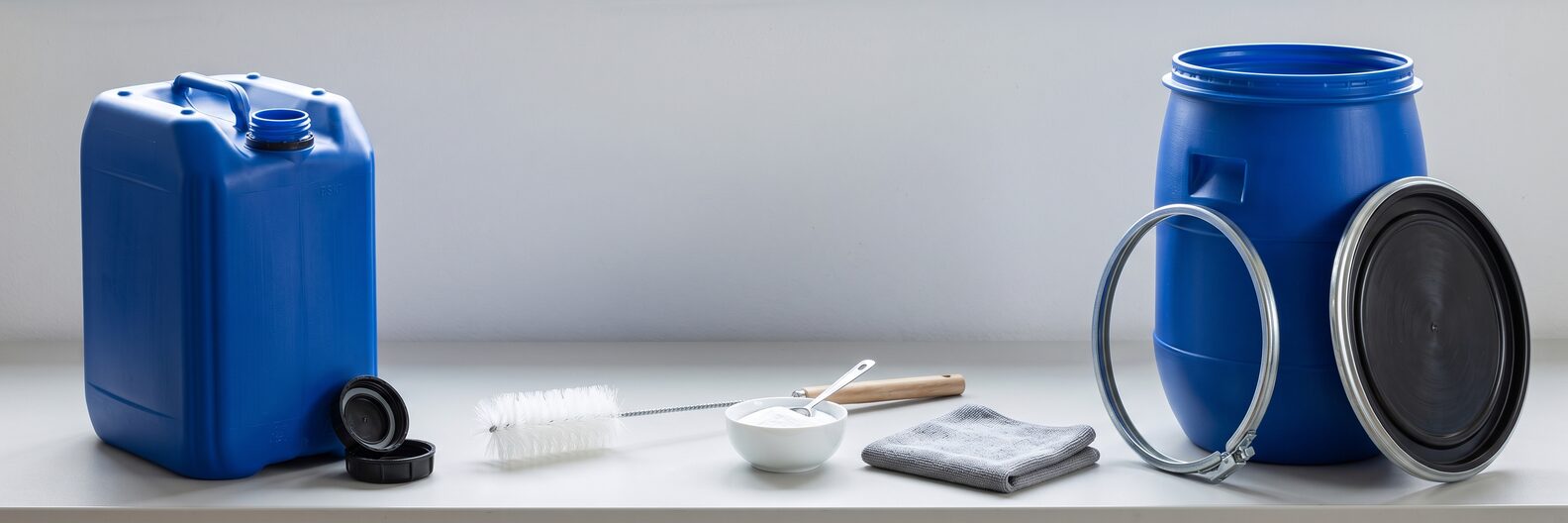
Clean in three steps: rinse, loosen mechanically, disinfect if needed. For everyday use, lukewarm water, a little washing-up liquid and a long brush are enough. Citric acid tackles limescale; bicarbonate of soda or washing soda deals with odours and grease. If a slimy coating has already formed inside the container – a biofilm – household remedies will not get you any further: you then need active oxygen based on sodium percarbonate or, for drinking water, water purification tablets. The most important limit: the water must be no hotter than 60 °C, otherwise the plastic warps. And never scour – every scratch is a new hiding place for germs.
The three steps
- Rinse: flush out residues immediately after emptying, ideally twice with clean, lukewarm water. Anything fresh comes off without chemicals. Dried-on residues take many times the effort later.
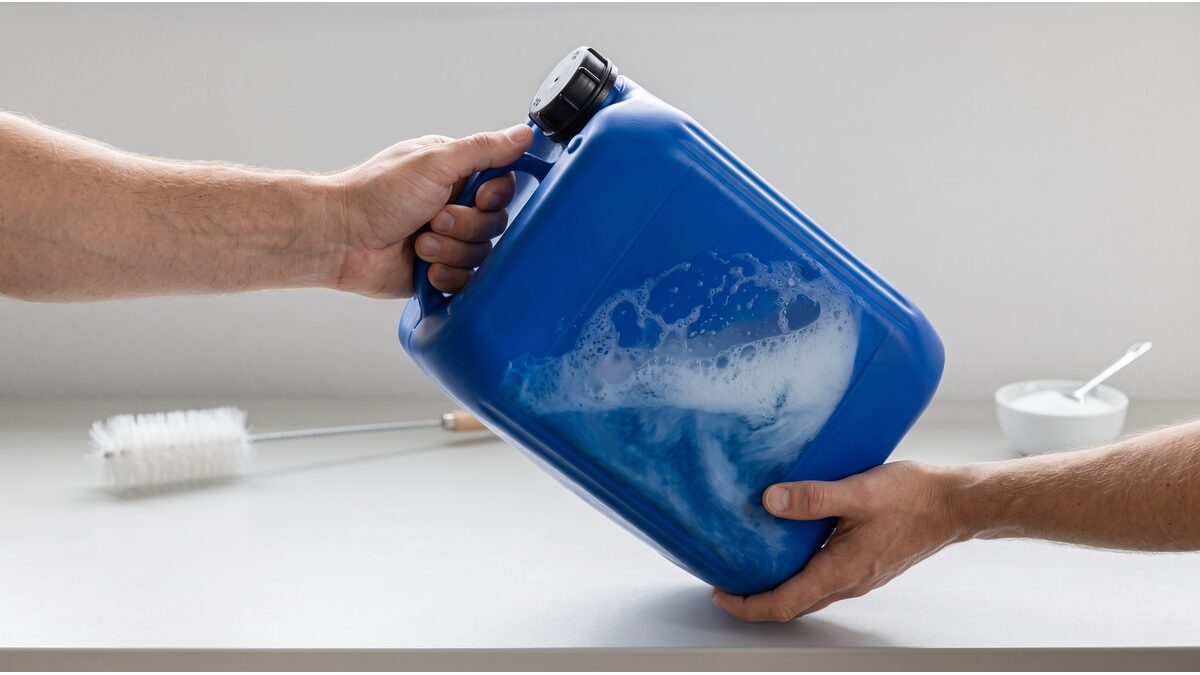
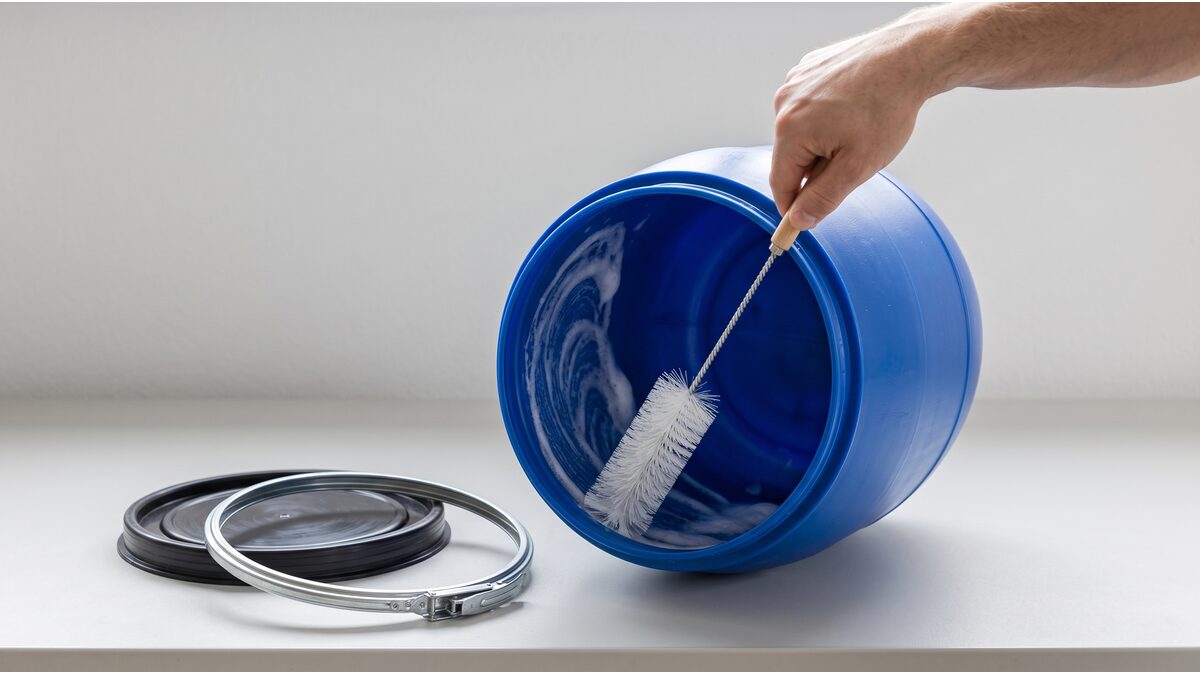
- Loosen mechanically: deposits need friction. For drums with a removable lid, work with a brush and sponge. For canisters too narrow to get a hand into, pour in two fingers' depth of lukewarm water with a dash of washing-up liquid and shake vigorously. A handful of rice or clean gravel acts as an abrasive without scratching the wall.
- Disinfect: only necessary if the container is to hold drinking water or food, or if it has been standing unused for a long time. A thoroughly rinsed rainwater container does not need disinfecting.
Which cleaning agent for what
- Washing-up liquid: grease and fresh residues. Rinse thoroughly afterwards, otherwise it will foam the next time you fill the container.
- Bicarbonate of soda or washing soda: odours and greasy films. About one tablespoon per litre of warm water, left to work for several hours. Both clean, but neither disinfects.
- Citric acid: limescale and discolouration. It does little against biofilm, and at high concentration it can attack plastic. Use it sparingly and do not leave it overnight.
- Active oxygen (sodium percarbonate): the agent of choice against biofilm, familiar from home brewing. Around 4 grams per litre of water at 40 to 50 °C, left to work for three to five minutes. The solution loses its effect after 15 to 20 minutes, so make it up fresh and mix only as much as you will use straight away.
- Water purification tablets: for drinking water and emergency supplies. They disinfect the water and the container if you swirl the ready-made solution around inside it. Dosage and waiting time are given on the pack.
What not to do to the plastic
Our canisters and drums are made of HDPE. The material is dimensionally stable between about −50 and +70 °C, but warps if kept above 60 °C for long. It follows that:
- No boiling water. Lukewarm up to a maximum of 60 °C is perfectly adequate for any cleaning.
- Not in the dishwasher. The temperatures there exceed the limit, and canisters come out deformed.
- No scouring agents, wire brushes or pan scourers. You will never get scratches out again, and they are exactly where the biofilm you wanted to get rid of settles.
- No solvents such as acetone, thinners or petrol for cleaning. They leave an odour in the material that later migrates back into the contents.
- Do not dry in blazing sun. Over the years, UV radiation makes the plastic brittle.
Narrow neck or wide neck: access is what matters
How thoroughly you can clean depends on the opening. An open-top drum opens fully and can be wiped out like a bucket – the most convenient case. A screw-lid drum has a large but fixed opening: a brush fits, a hand usually does not. Depending on their DIN thread, canisters have an opening of only 45 to 71 millimetres, so shaking and rinsing is all you can do. If you need to clean thoroughly on a regular basis, bear this in mind when buying and choose an open-top drum.
Clean the cap and seal separately. There is often more build-up in the thread and under the sealing washer than in the container itself. If seals are hard, cracked or smell, replace them – matching lids and caps cost little.
By intended use
Drinking water and emergency supplies. Rinse before filling for the first time, then after every emptying. If the canister is going into storage, clean it, dry it completely and only rest the cap loosely on top. If a filled canister is stored for a longer period, add a purification tablet to the water. A canister that has once held fuel or cleaning agents will never be a drinking water canister again – the odour stays in the material.
Fermentation drum and food drum. Here hygiene is not a matter of convenience but of results. Clean with active oxygen before every batch, rinse with clean water and let the drum drain. If you use a fermentation drum, pay particular attention to the airlock, the sealing ring and the channel of the water seal. How to get the batch itself right is explained in the guide to sauerkraut in a fermentation drum. Why the container must be approved for food in the first place is explained in the guide food-safe.
Water butt. The effort is worthwhile once a year, ideally in late autumn before the frost. Empty the butt, remove leaves and sludge from the bottom and scrub the wall with a brush and clean water. Algae are not a hygiene problem but a light problem: a tight-fitting lid and a shady spot prevent them better than any product. Chemicals have no place in garden water, which ends up on the plants. More on this in the guide drum as a water butt.
Fuel, oil and chemicals. Canisters like these are not cleaned with water; instead, rinse them out with a small amount of the same substance and dispose of this rinse at the recycling centre. Water causes metal parts to rust and is almost impossible to remove completely from a narrow-neck canister. These containers stay permanently assigned to their purpose and are labelled.
Drying and storage
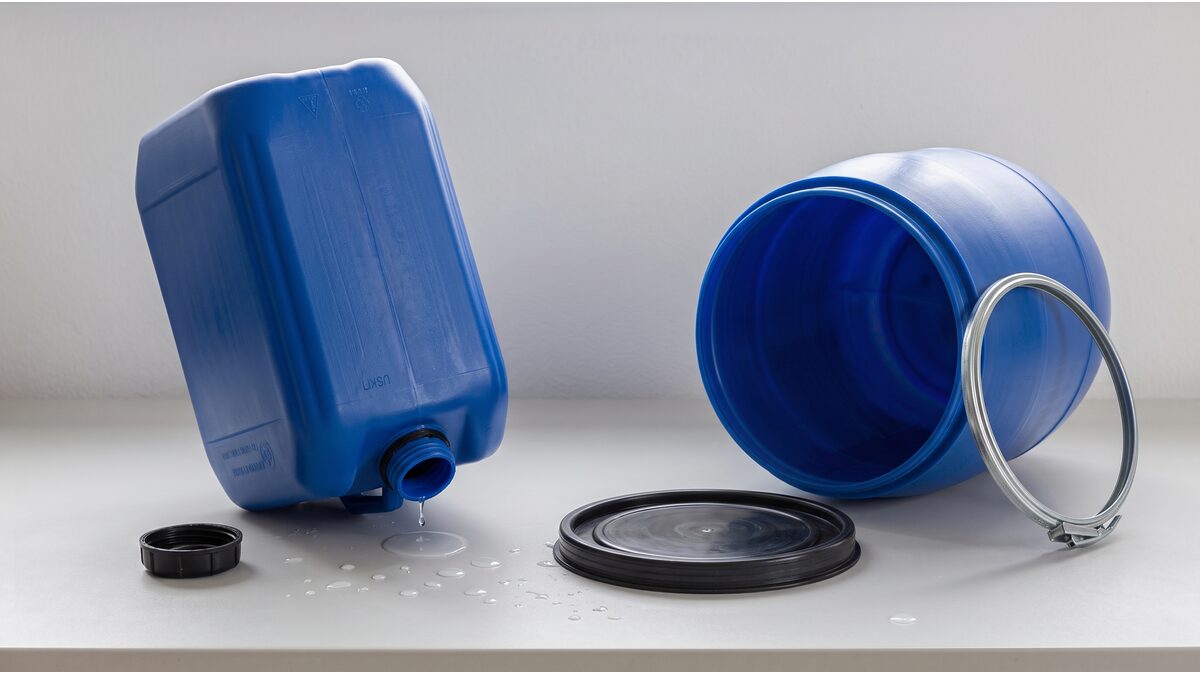
The most common mistake happens after cleaning. A container closed while still damp is the perfect breeding ground: within a week it smells musty, within four weeks the biofilm is back. So stand canisters and drums upside down or at a steep angle until there really is not a drop left inside. Then store them in a cool, dark place with the cap resting loosely on top, not screwed down. Clean and dry the funnel and the brush at the same time.
When a container should be replaced
Plastic lasts a long time, but not forever. Replace a container when the inside wall is badly scratched or has turned milky and dull, when an odour remains even after thorough cleaning, when hairline cracks appear or when the material cracks instead of giving when you press it. For containers used for drinking water and food, if in doubt: buy new. A canister costs less than a spoilt supply.
Frequently asked questions
Is vinegar enough to disinfect? No. Vinegar dissolves limescale and removes odours, but it is too weak against biofilm and germs. Use water purification tablets for drinking water containers and active oxygen for food drums.
How often do I need to clean? Give it a quick rinse after every emptying. Clean thoroughly before each new use, about every three months for permanently filled drinking water canisters, and once a year for the water butt.
The canister still smells after drying. What can I do? Leave it overnight with a bicarbonate of soda solution, rinse it out and let it dry completely with the cap off. If the odour remains, it has set into the plastic and will not go away. The container is then only suitable for its original purpose.
Can I use a pressure washer? For the inside of drums, yes, in exceptional cases, from a distance and with a flat jet. Do not hold the jet on one spot: a pinpoint jet removes material and leaves exactly the rough surface you want to avoid.
Not sure which container is right for your purpose? The guide drum types explained compares the designs, and we are happy to advise you personally by e-mail at info@wilaigmbh.de.
As of: September 2026


