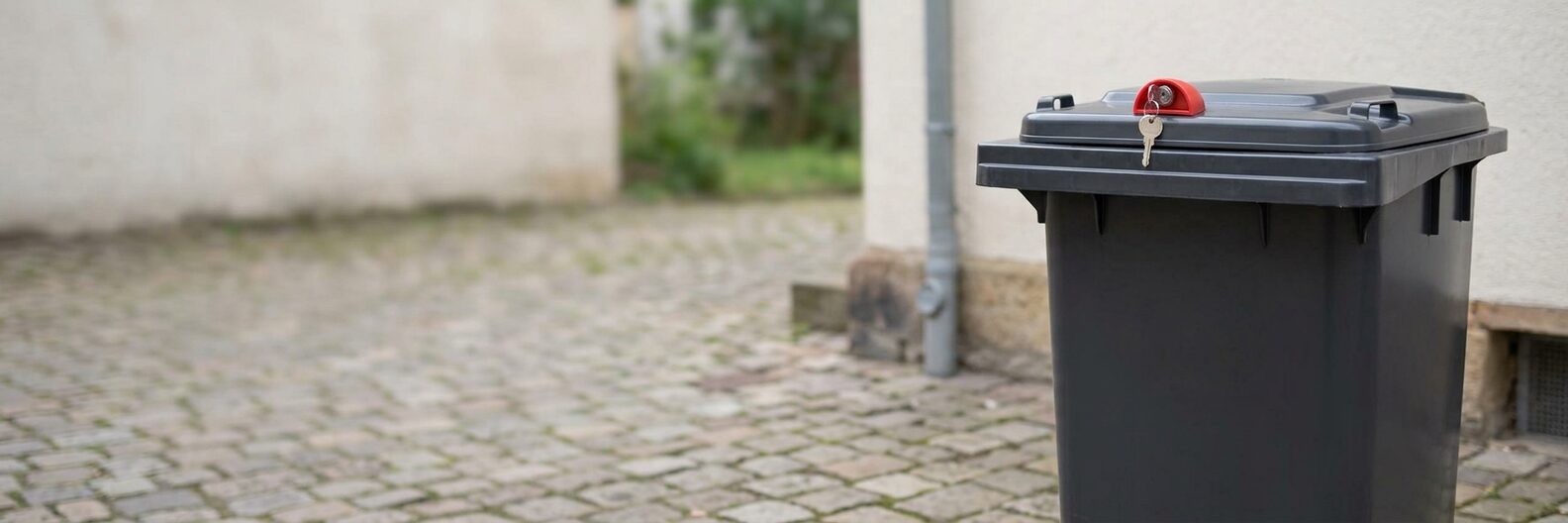
The short answer
A gravity lock is the only type of bin lock that does not hold up the refuse collectors: in everyday use the lid can only be opened with the key, but when the bin is tipped over the hopper of the refuse truck it unlocks by itself and locks again when the bin is set down. We stock two proven systems for all common two-wheeled bins from 60 to 360 litres: the Sudhaus gravity lock from Iserlohn and the O.M.R. universal lock from Turin, each with a lock cylinder, two keys, drilling templates and instructions. Fitting takes around fifteen minutes with a drill. If the bin belongs to the council or the waste contractor rather than to you, ask before drilling – many contractors offer gravity locks themselves or explicitly permit them.
Why lock a bin at all?
People who lock their bin usually have one of these reasons:
- Unauthorised dumping: neighbours, passers-by or businesses dispose of their waste in other people's bins. On collection day your bin is full even though you have hardly put anything in it. With incorrect sorting (household waste in the paper bin, say), in the worst case the bin is left unemptied – and the hassle and surcharges land on the bin owner, not the culprit.
- Saving on charges: where fees are based on volume or the number of collections, a smaller bin or a longer collection interval only pays off if nobody else is filling it. The lock makes the calculation reliable.
- Storms and vandalism: if a locked bin blows over, the lid stays shut. The contents do not end up across the yard and the street.
- Animals and rummaging: a locked lid keeps out crows, rats, raccoons and curious hands – especially on food waste and general waste bins.
How a gravity lock works
The lock consists of an upper section screwed to the front edge of the lid and a lower section on the bin body. As long as the bin is upright, a bolt holds the lid shut; it can only be opened with the key. When the lifter raises the bin and tips it upside down into the hopper, the bolt slides under its own weight and releases the lid – the waste falls out just as with any other bin. When the bin is set back down, the bolt drops back into its locked position. The collectors therefore need neither key nor code, and you have nothing to unlock on collection day. The principle works equally well with rear loaders and side loaders, because in both cases the bin is emptied upside down. If the bin merely falls over, on the other hand, the angle is not enough to unlock it – the lid stays shut. The Sudhaus system also includes a child safety feature.
Sudhaus or O.M.R. – which lock is right?
| Sudhaus gravity lock | O.M.R. universal bin lock |
|---|
| Manufacturer | SUDHAUS GmbH, Iserlohn (Sauerland), made in Germany | O.M.R. Serrature, Borgaro Torinese near Turin, made in Italy |
| Fits | Two-wheeled bins with standard and EURO2 lids, designed for SULO | Two-wheeled bins from almost all brands: SULO, Weber, Kliko, Paul Craemer, SSI Schäfer; standard and EURO2 lids |
| Locking | Lock cylinder with 200 different key combinations; master-key-compatible version on request | Lock cylinder, either keyed alike or keyed to differ |
| Supplied with | Lock, 2 keys, drilling templates, fitting instructions | Lock, 2 keys, drilling templates, fitting instructions |
| Weight / dimensions | approx. 0.74 kg | approx. 0.74 kg, 20 × 15 × 4.5 cm |
| Typical for | Individual bins, existing SULO stock, preference for a German brand | Mixed bin stock, property managers with many bins (keyed alike) |
Both systems work on the same gravity principle and are similarly priced. The difference lies in key management and in your bin stock: if you only have SULO bins and need a lock for one or two of them, Sudhaus is a good choice. If you want to manage many bins from different manufacturers with a single key, go for the keyed-alike O.M.R. lock. All versions can be found in the category Sudhaus/OMR locks.
Keyed alike or keyed to differ?
Keyed alike means all locks in one order open with the same key. This is the choice for landlords, property managers and businesses – one key on the caretaker's ring opens the general waste, paper and food waste bins. Order keyed-alike locks in a single transaction wherever possible so that all cylinders belong to the same key combination.
Keyed to differ means each lock has its own cylinder and key, and no key opens anyone else's bin. This is right when several parties are billed separately or should only have access to their own bin – commercial tenants sharing a yard, for example, or neighbours with a shared bin store. Practical tip: assign the key pairs to the bins when fitting and write the allocation down. For larger properties with an existing master key system, ask about the master-key-compatible Sudhaus version.
Which lid is on my bin?
Two-wheeled bins come with two common lid shapes: the standard lid (flat, with a recessed grip on the front edge) and the EURO2 lid, recognisable by its raised profile or the continuous grip bar along the front edge. Both locks we stock fit both lid types. What matters more is the condition: a brittle or cracked lid will not hold a lock. Replace it first – the guide Replacing a wheelie bin lid explains how. With SULO it is worth checking the year of manufacture: Classic bins up to 2022 and Citybac models from 2022 onwards have different lids. If you are unsure which bin you have, our team can help by e-mail at info@wilaigmbh.de with the manufacturer, size and year of manufacture.
Am I allowed to drill into my bin at all?
That depends on who owns the bin. Bins you own – such as SULO bins bought from us for businesses, property managers or councils with a purchase scheme – can be fitted out however you like. Bins provided to you remain the property of the council or the waste contractor; the local waste regulations apply, and you should obtain permission before drilling. The good news: gravity locks are well established with waste contractors because they do not disrupt the emptying process. Many German councils even offer them themselves – the city of Arnsberg sells the lock for 37.50 euros with optional fitting, the Hohenlohe district fits bins from 40 to 1,100 litres for a one-off 60 euros including installation, the city of Hamm on application for a surcharge, and Düsseldorf's AWISTA rents out locks for two-wheeled bins from 60 to 240 litres. Where the contractor has no offer of its own, a short enquiry stating the bin number and lock type is usually enough. Bins locked without a gravity function (padlock, chain), on the other hand, are frequently left unemptied.
Fitting in fifteen minutes
Both locks come with drilling templates. Using the Sudhaus system as an example, fitting goes like this:
- Prepare: empty and dry the bin. You need a drill or cordless screwdriver, 5, 10 and 12 mm drill bits, a screwdriver and a pen.
- Mark the centre: mark the centre of the bin body on the front. Fold the body templates (B and C), fit them together and hold them against the mark.
- Close the lid: with the lid closed, the template slides into its final position. Open the lid, mark the two drill holes on the bin body and remove the template.
- Mark the lid: fold the lid template (A), stand it on the mark, close the lid and mark three drill holes.
- Drill: pre-drill with the 5 mm wood bit, then open up four holes to 10 mm and one hole to 12 mm.
- Screw on: fit the upper and lower lid sections, the body section and the bush section and screw them together with the fixings supplied. No more than 3 Nm of torque – HDPE is tough, but over-tightened screws tear out.
- Test the function: lock the lid, open it with the key, then carefully tip the empty bin upside down: the lid must swing open freely and lock again when the bin is stood upright.
Observe the load limit: Sudhaus rates its locks for a filling weight of bin volume × 0.4 – 48 kg for a 120-litre bin, 96 kg for 240 litres. This matches the usual maximum weights under EN 840 and is hardly ever reached in everyday use.
What a bin lock cannot do
- Prevent theft of the whole bin. That requires a chain at the bin store or a lockable bin enclosure.
- Work without drilling. Clamp fasteners and straps need no holes, but have to be released by hand on every collection day – otherwise the bin is left full. As a permanent solution they are inferior to the gravity lock.
- Replace a broken lid. The lock needs an intact lid that closes flat.
Maintenance is minimal: wipe dirt off the cylinder and keep it moving with graphite or PTFE spray once or twice a year, never oil, which gums up in frost. Any locksmith can cut spare keys; a spare key should have a fixed place from day one.
What about 660 and 1,100-litre containers?
For four-wheeled containers Sudhaus also makes gravity locks, designed for the SULO MGB 1100 with flat lid and prepared for a profile half cylinder so that the container can be integrated into an existing master key system. Because lid shapes and contractor practice vary more for large containers – some contractors fit 1,100-litre bins, others explicitly exclude four-wheeled containers – we advise individually here: tell us the manufacturer, lid type (flat or domed) and contractor, and we will check fit and availability.
Frequently asked questions
Do the refuse collectors need a key? No. The gravity lock unlocks by itself when tipped on the truck and locks again when the bin is set down.
Does the lock fit food waste, paper and yellow recycling bins? Yes, what matters is the bin design (two wheels, standard or EURO2 lid), not the colour.
What happens to the lock if the bin is replaced? It can be unscrewed and moved to an identical bin; the drill holes stay in the old bin.
Can I have the same key for all the bins at one property? Yes, with the keyed-alike version – ideally all locks in a single order.
Does the lock help save on charges? Indirectly: without unauthorised dumping, a smaller bin or fewer collections are often enough, which is noticeable with volume- or collection-based fees.
Last updated: September 2026
As of: September 2026


