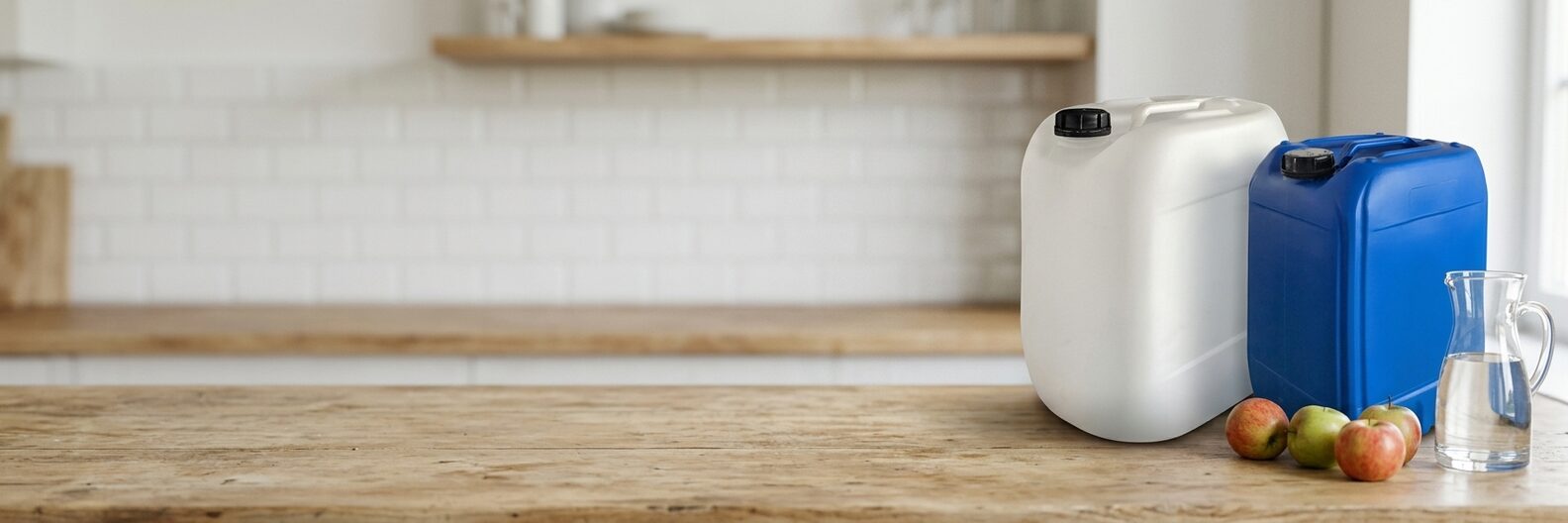
In short: a container is food-safe if, in normal use, its material does not transfer substances to the food in quantities that could endanger health and does not change its smell, taste or composition. In the EU this is governed by Framework Regulation (EC) No 1935/2004 and, for plastics, additionally by Regulation (EU) No 10/2011 with its positive list and migration limits. Food safety can be recognised by the glass-and-fork symbol, the statement "for food contact" or the manufacturer's declaration of conformity. All HDPE canisters, drums, buckets and bottles in our shop carry the entry "Food-safe: yes" in their technical data.
What the law requires
Regulation (EC) No 1935/2004 applies to all materials in contact with food, from canisters to chopping boards. Its core, Article 3: articles must be manufactured in accordance with good manufacturing practice and must not transfer their constituents to food in quantities that could endanger human health, bring about an unacceptable change in the composition of the food or deteriorate its smell and taste.
For plastics, Regulation (EU) No 10/2011 makes this specific: only monomers and additives from the positive list may be used. The overall migration limit is 10 milligrams per square decimetre of contact surface (60 milligrams per kilogram of food for packaging intended for infants), and specific limits additionally apply to individual substances. The manufacturer demonstrates compliance with migration tests in simulants such as water, ethanol or acetic acid and issues a declaration of conformity that is passed along the supply chain. In Germany the Food and Feed Code (sections 30 and 31 LFGB) supplements the EU rules.
How to recognise food-safe containers
- Glass-and-fork symbol on the container, label or packaging. It may be omitted where the intended use is obvious, such as with a drinking bottle.
- Statement "for food contact" or "food-safe" in the product description and technical data.
- Declaration of conformity from the manufacturer: for businesses and public authorities this is the actual document. Ask for it if you store or fill food commercially.
- Material marking in the recycling triangle: 02 stands for HDPE, 05 for PP. Both are common in food grade, but the marking alone is not proof.
HDPE, PP and the question of BPA
Our canisters, drums, buckets and bottles are made of HDPE (high-density polyethylene), lids and closures mostly of PP (polypropylene). Both plastics are odour-neutral, shatterproof, dishwasher-safe and resistant to water, acids, alkalis, alcohol and oils. They need no plasticisers and, by their chemistry, contain no bisphenol A: BPA is a building block of polycarbonate and epoxy resins, not of polyethylene. The "BPA-free" statement on our canisters is therefore not a special feature but a material property that we make visible.
Two qualifications belong to an honest answer: recyclate (reprocessed plastic) may only come into contact with food after an approved process, and colour pigments must likewise come from the positive list. That is the case with our blue and natural white canisters; with no-name goods from an unknown source you should ask.
Food-safe, suitable for drinking water, UN-approved: three different things
| Term | Means | Relevant for |
|---|
| Food-safe | Material does not transfer harmful substances to food (Reg. 1935/2004, Reg. 10/2011) | Water, juice, cider, brine, flour, sugar, animal feed |
| Suitable for drinking water | Food-safe plus hygienic handling: store clean, closed, cool and dark | Drinking water supplies, camping, emergency preparedness |
| UN approval | Packaging for the transport of dangerous goods under ADR, tested for drop, stacking load and leak-tightness | Chemicals, solvents, dangerous goods; says nothing about food suitability |
A UN canister can be food-safe, but does not have to be. Conversely, a drinking water canister needs no UN approval. For drinking water we recommend natural white or blue canisters made of food-safe HDPE that have never been filled with anything else.
Storing food properly: practical tips
- Use for one purpose only. A canister that has once held cleaning agent or oil remains a cleaning agent or oil canister. HDPE absorbs odours that cannot be removed reliably.
- Rinse before first use with hot water and a little washing-up liquid, rinse thoroughly and leave to dry open.
- Change drinking water regularly. Stored cool and dark, tap water stays perfectly fine in a closed canister for a few weeks; for emergency supplies, Germany's Federal Office of Civil Protection recommends replacing stocks at regular intervals.
- Keep out of the sun. UV light makes plastic brittle over time and warms the contents; cover drums and canisters outdoors.
- Choose the right container: canisters from 3 to 30 litres for water and drinks, lidded drums for sauerkraut, mash and stores (see the guide Sauerkraut in a fermentation drum), buckets with lids for pastes and powders, wide-neck and narrow-neck bottles for the laboratory and kitchen.
Frequently asked questions
Is every blue canister food-safe? No. The colour is a convention, not proof. What counts is the declaration of conformity and the retailer's statement.
Are tinplate canisters food-safe? Internally lacquered tinplate canisters yes, plain tinned ones depending on the contents; they are common for oils and spirits, while for acidic foods the internal lacquer must be suitable.
May I store food in a UN-approved canister? If it is additionally declared food-safe, yes. UN approval alone says nothing about food contact.
How long does an HDPE canister last? Many years if stored out of direct sunlight. Replace it when it becomes milky and brittle, shows cracks or odours no longer go away.
What does "migration" mean? The transfer of substances from the container material into the food. The limits in Regulation 10/2011 restrict precisely this transfer.
Last updated: September 2026
As of: September 2026


