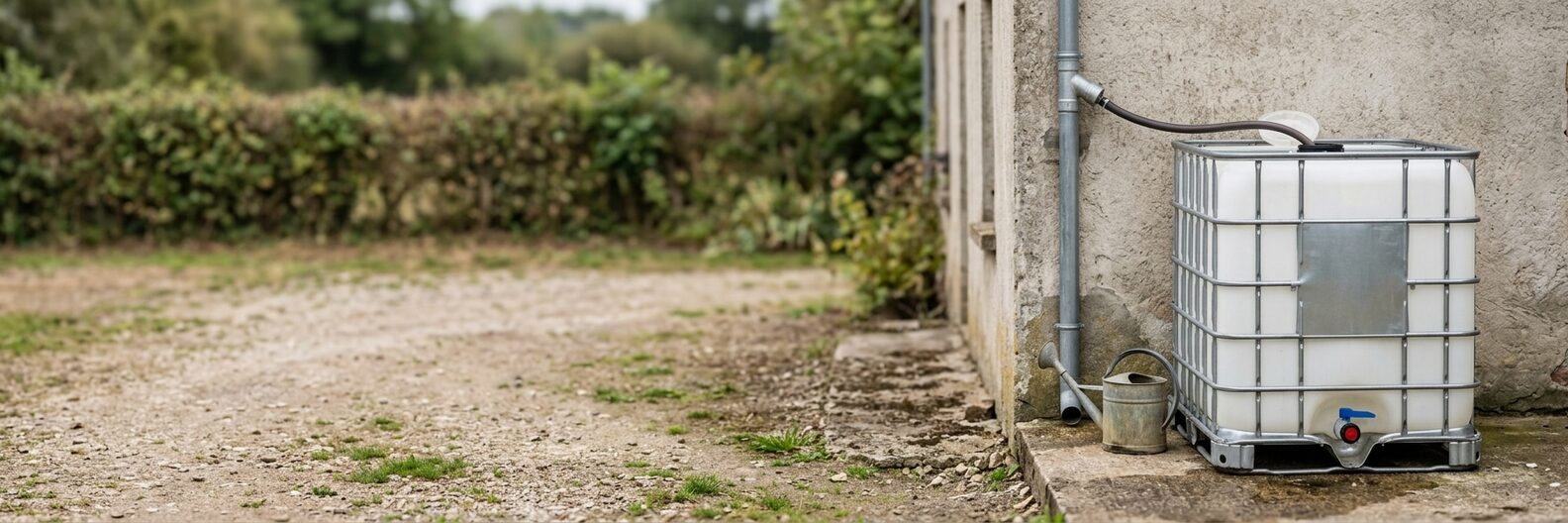
In short: an IBC (Intermediate Bulk Container) is a large-capacity container for 300 to 1,000 litres of liquid: an HDPE plastic bottle inside a galvanised steel cage on a pallet, with a screw lid on top and an outlet valve at the bottom. It sits between the drum (up to 220 litres) and the tanker, can be moved with a pallet truck or forklift, stacked and emptied directly through the valve. Private households mostly come across it as a rainwater tank, businesses as a transport and storage container for chemicals, oils, cleaning agents and food raw materials.
We do not stock IBCs – here is what we have instead
Up to 220 litres a drum covers most uses: rainwater, storage, transport. The trade-off is set out further down under “When a drum is the better choice”.
How an IBC is built
- Inner bottle: extrusion blow-moulded HDPE tank, usually translucent natural white so you can see the fill level; also available in black for UV-sensitive contents.
- Cage: welded steel tube frame, hot-dip galvanised. It carries the load of the contents and makes the IBC stackable.
- Pallet: wood, plastic, galvanised steel or composite. Plastic and steel pallets are more hygienic and longer-lasting, wood is cheaper.
- Lid: screw lid with a diameter of 150 or 225 mm, often with a vent valve.
- Outlet valve: DN 50 ball or butterfly valve with an S60x6 thread to which couplings, hoses and taps can be connected.
Sizes, dimensions and weights
| Volume | External dimensions (L × W × H) | Empty weight | Weight filled with water |
|---|
| 1,000 litres | 1,200 × 1,000 × approx. 1,160 mm | approx. 50–65 kg | approx. 1,050–1,070 kg |
| 600 litres | 1,200 × 800 × approx. 1,010 mm | approx. 40–50 kg | approx. 650 kg |
| 300 litres | 800 × 600 × approx. 1,000 mm | approx. 23 kg | approx. 325 kg |
The footprint of the 1,000-litre IBC matches an industrial pallet. That makes it practical for logistics, but it demands a firm, level base: a tonne of water on little more than a square metre presses paving and lawn edging into the ground. A concrete slab, compacted gravel or a strip foundation is a must.
New, rinsed, reconditioned or rebottled?
These terms decide the price and the use:
- New: unused, with a declaration of conformity for food contact or UN approval. The right choice for drinking water, food raw materials and anything that must be verifiably clean.
- Rinsed (used): the previous contents have been rinsed out and the IBC has been leak-tested. Sufficient for rainwater, irrigation water and grey water, not for drinking water or food. Ask about the previous contents when buying.
- Reconditioned: cleaned, inspected, damaged parts replaced.
- Rebottled: used cage with a brand-new bottle. Technically almost as good as new, considerably cheaper, often with UN approval.
UN approval: when it is required
An IBC with a UN marking (for example 31HA1/Y) may carry dangerous goods of packing groups II and III, such as cleaning agents, acids, alkalis or flammable liquids of the permitted class. Inspection intervals apply for dangerous goods: a leak test every two and a half years and replacement of the inner bottle after five years. If you only collect rainwater or store brine, you do not need UN approval.
The IBC as a rainwater tank: what to look out for
- Algae: the translucent bottle lets light through and the water turns green in summer. The remedy is a black bottle, a light-proof cover or a timber surround that also blends the tank into the garden.
- Frost: empty before the first frost or fill to no more than 85 per cent so the ice can expand; open the valve, otherwise it will burst.
- Mosquitoes: keep the lid closed and fit a filter basket to the inlet.
- Connection: adapters to 3/4-inch or 1-inch threads fit the S60x6 outlet, and a garden hose can be connected directly. The pressure stays low: a full IBC delivers around 0.1 bar at ground level.
When a drum is the better choice
An IBC is worthwhile when more than 300 litres are regularly involved and a forklift or pallet truck is available. For the home, garden, workshop and small businesses, drums and canisters are usually more practical: they fit through doors, can be moved by hand, cost less and need no foundation. As a rule of thumb: a 1,000 litre IBC equals roughly five 220 litre drums; for most rainwater setups two or three are enough. We do not currently stock IBC containers, but we do carry the complete range below them:
For trade enquiries about bulk containers, we are happy to help by e-mail at info@wilaigmbh.de with an assessment of which container suits your application.
Frequently asked questions
What does IBC stand for? Intermediate Bulk Container: bigger than a drum, smaller than a tank.
How much does a full 1,000-litre IBC weigh? Around 1,050 to 1,070 kg with water, correspondingly more with denser liquids.
Can I use a second-hand IBC for drinking water? Only if it is new or rebottled and has food contact conformity. Rinsed used IBCs are intended for rainwater and grey water.
Can I stack two IBCs? Empty, yes; full, only if the manufacturer and pallet type explicitly allow it; in the garden a full IBC should always stand on the ground.
What is S60x6? The coarse standard thread on the outlet valve, 60 mm in diameter with a 6 mm pitch. Adapters to common hose and pipe threads are available from specialist suppliers.
Last updated: September 2026
As of: September 2026


