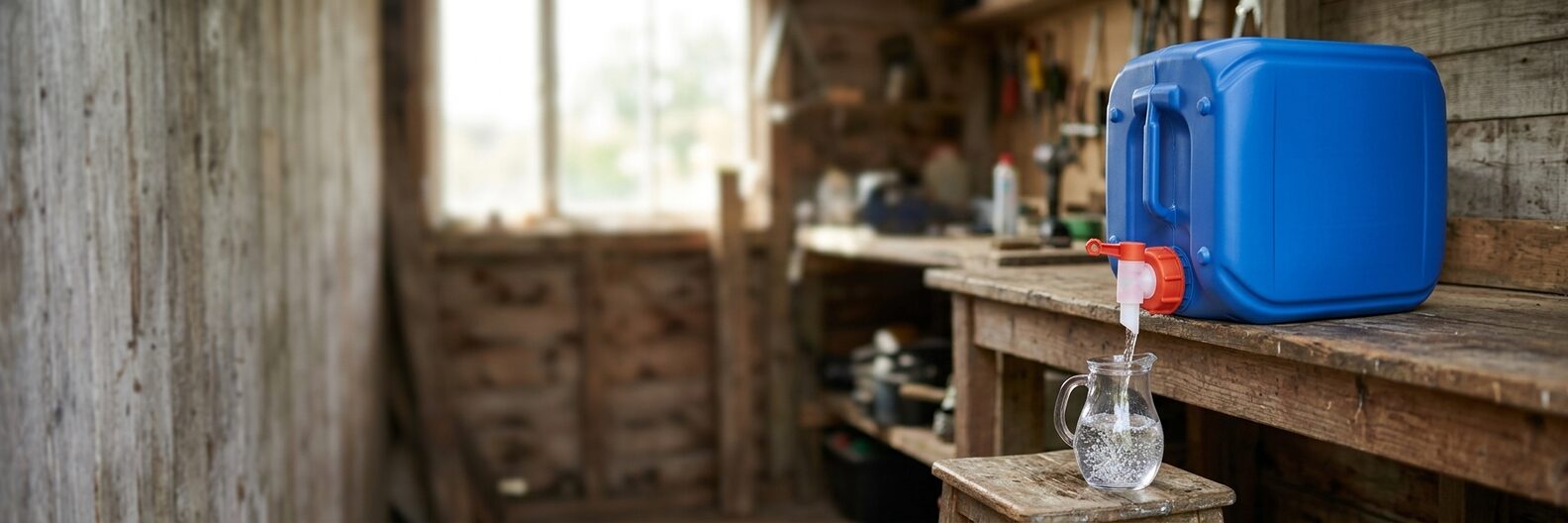
In short: an AFT tap (AirFlow Tap) is a dispensing tap for plastic canisters that lets air into the canister while you draw off liquid. No vacuum builds up, the canister does not "gurgle", the flow stays even and does not splash. The tap is screwed onto the canister thread in place of the original cap and is available for the DIN 45, DIN 51 and DIN 61 threads, made of food-safe HDPE with a flow rate of around 5 litres per minute.
Why an ordinary tap gurgles
When liquid flows out of a closed canister, the same volume of air has to flow back in. With a simple dispensing tap this can only happen through the tap itself: the stream breaks off, air bubbles in, the stream starts again. This gurgling wastes time and splashes, with oils or cleaning agents also beside the target. The classic remedy is a second hole with a vent valve in the canister wall. The AFT tap solves this more elegantly: a vent channel in the tap body guides air past the liquid stream into the canister. Open the tap and liquid flows out at the bottom while air flows in at the top. The canister stays closed and no extra hole is needed.
Which AFT tap fits my canister?
What matters is the thread of the canister opening. The DIN number gives the outer thread diameter in millimetres; for our canisters it appears in the product name and in the technical data.
| Thread | Typical canisters | Matching tap |
|---|
| DIN 45 | 3, 5 and 10 litres (small opening) | AFT tap DIN 45 |
| DIN 51 | 10 litres blue, many 5 to 20-litre canisters from other manufacturers | AFT tap DIN 51 |
| DIN 61 | 20, 25 and 30 litres | AFT tap DIN 61 |
What exactly the DIN figures mean and which other accessories fit is explained in the guide Canister caps: DIN 45, 51, 61 and 71. If you have canisters of different sizes, go for the universal set with AFT tap: one tap with a 3/4-inch male thread plus adapter caps for all common openings. To get started there is also the set 3 × 25-litre canisters with one AFT tap and three caps: the tap moves to whichever canister is currently in use.
Fitting in one minute
- Unscrew the original cap and check that a seal is seated in the tap. The seal stays in the tap, not in the old cap.
- Screw on the AFT tap hand-tight. No tools, no force: HDPE threads seal through the gasket, not through tightening torque.
- Position the canister. The tap must be at the bottom: lay the canister on the edge of a table or on a canister stand, or tip it onto its side so that the outlet hangs free and the vent channel is at the top.
- Dispense. Open the tap, hold the vessel underneath, close the tap. The tap also seals when a full canister is lying down; for transport, screw the original cap back on all the same.
What the AFT tap is suitable for
- Water: camping, building sites, garden sheds, emergency supplies. The tap is food-safe and the canister should be too, see the guide What does food-safe mean?
- Oils, antifreeze, screenwash, cleaning agents: HDPE is resistant to most oils, alkalis and diluted acids. With aggressive chemicals, check the resistance of the canister, not just the tap.
- Drinks and food: juice, cider, brine: rinse the tap and canister with hot water after use, no solvents.
- Not suitable: fuels. Petrol and diesel belong in approved fuel canisters with a matching spout.
Alternative: retrofitting a vent tap
If you already have an ordinary dispensing tap or a canister with a built-in tap, the gurgling can also be stopped retrospectively: the vent and bleed tap with mounting tip is pushed through the wall on the top of the canister lying on its side and opened while dispensing. With the AFT tap this step is unnecessary, because the venting is built into the tap.
Frequently asked questions
Does a DIN 51 tap fit a DIN 61 canister? No. The threads are not compatible; only the exact DIN number counts, or the universal set with adapters.
Does the tap drip when closed? Not with the seal correctly seated. If it drips at the thread, the seal has usually slipped or the tap has been over-tightened and the seal deformed.
How fast does the AFT tap dispense? Around 5 litres per minute with a full canister, slightly less as the level drops.
Can the tap stay on the canister? Yes, for everyday use. For transport in the car or when the canister is stacked, we recommend the original cap.
Is the tap dishwasher-safe? HDPE tolerates hot water; we recommend washing by hand so the seal does not shift.
Last updated: September 2026
As of: September 2026


